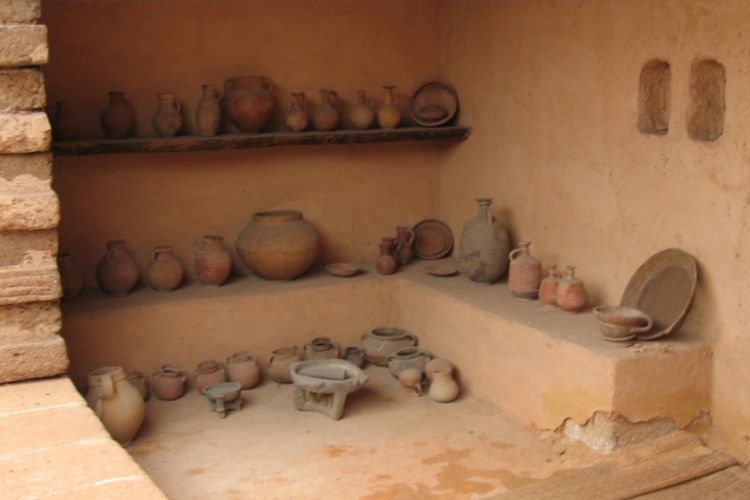
Potters and clay held significant importance in ancient times. Clay was used to make a wide variety of objects such as pots and pans, plates, water containers and storage vessels. Additionally, it was employed to make shipping containers, kilns, ovens, and lamps.
The image of a caravan of laden camels and donkeys, with clay pots hanging from their bundles or saddles, is one that fascinates us today. But it also highlights how versatile and necessary clay was in this period.
The importance of pottery
Fortunately, clay was readily available in Palestine, making it a widely accessible resource. Its abundance facilitated the production of a wide range of utilitarian and artistic objects, making a considerable contribution to the material culture of the region.
The presence of pottery wheels and clay pits further illustrated the prevalence of pottery production, as these essential elements of the craft were found throughout the country. The clay pits, which served as the initial stage of the pottery making process, were a familiar sight and testified to the long tradition and expertise in working with clay in ancient Palestine.
The process of making pottery begins with finding the perfect clay. He observes the land, looking for telltale signs of clay deposits. The weathered, cracked appearance of dried earth that resembles tree bark catches the potter’s eye, suggesting the presence of clay beneath the surface.
Similarly, areas that retain water after heavy rains provide another possible clue, suggesting the presence of clay soil awaiting excavation and transformation within the potter’s workshop.
This initial stage marks the beginning of a journey from the discovery of raw materials to the creation of beautiful and functional pottery, as the skill and craftsmanship of the potter brings artistry from the earth itself.
The Potter’s Hand Is Essential in Molding the Clay
Scripture uses clay as an analogy for how we are formed by the master potter. Just as clay needs the skilled hands of a potter to mould it into an object of beauty and purpose, so we need God’s intervention to transform us into the image of Christ.
First, an assitant cleans the clay.
The process of preparing the clay for spinning requires a great deal of skill and physical effort. Clay can be a challenging material to work with, as it is often filled with sticks and stones, and its moisture content has to be just right. If the clay is too wet, it’s soupy and difficult to shape, while if it’s too dry, it’s hard and unyielding.
To overcome these challenges, the potter enlists the help of a dedicated assistant whose main task is to clean and manipulate the clay to achieve the desired consistency.
The assistant’s role is crucial in ensuring that the clay is in optimum condition for the potter to work with. This involves carefully adding water or sand to achieve the perfect texture, while kneading the clay with the hands and feet. This hands-on approach allows the assistant to fully understand the qualities of the clay and make precise adjustments to ensure it is prepared to the potter’s specifications.
Together, the potter and his assistant form a harmonious partnership, each contributing their expertise to transform raw clay into beautiful, functional pottery. This collaborative process underscores the intricate artistry and skill involved in working with this natural material, ultimately resulting in exquisite ceramic creations that reflect the dedication and craftsmanship of the artisans involved.
The Holy Spirit, our potter’s helper, puts us through a similar refining process. He helps us remove the spiritual debris and impurities that weigh us down, softening our hearts to be malleable in God’s hands. And strengthens our character to withstand the challenges and hardships that come our way.
This is about facing difficulties and changes, but it helps us grow personally and fulfill God’s plans for us. Thinking of ourselves as clay being shaped by a potter helps us stay humble and open to the things that shape us, like experiences, relationships, and personal growth. Just as clay is molded by the potter, we should be open to the lessons and chances that God sends us to change and improve ourselves.
Embracing the concept of a Potter working on us fosters a sense of humilty. And opens our hearts to the shaping forces in our lives, whether they be experiences, relationships, or personal development. Just as clay yields to the will of the potter, we should be receptive to the lessons and opportunities God sends to transform and perfect us.
Then the potter throws the clay
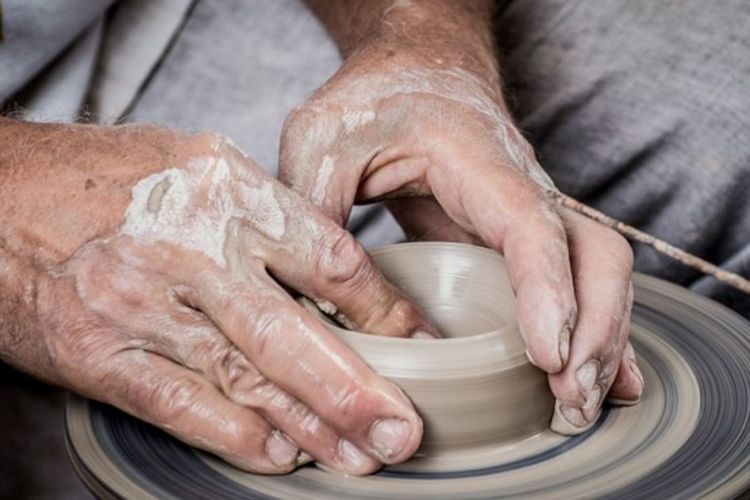
The process of preparing the clay and shaping it into pottery is a timeless art that requires skill, patience, and creativity. Once the clay is meticulously cleaned and prepared, the potter can then begin the transformational process. With a lump of clay in hand, the potter delicately “throws” or forms it as it gracefully spins on the wheel, using deft hands to guide and mold the material into the desired shape. Each movement is purposeful, each touch intentional, as the potter breathes life into the inert substance, coaxing out the potential within. It’s a mesmerizing sight to witness, as the once formless clay takes on new dimensions and contours, gradually revealing the artistic vision of the potter. The whir of the wheel and the dance of the potter’s hands become a symphony of creation, merging skill and inspiration into a harmonious whole. As the clay responds to the potter’s touch, it undergoes a metamorphosis, embodying the essence of the potter’s imagination. This captivating process not only yields beautiful pottery but also highlights the deep connection between the artist and the medium, a relationship that transcends mere craftsmanship and blossoms into an expression of artistry and ingenuity.
Once the clay is carefully cleaned and prepared, the potter begins his transformation work, throwing the clay on to the rapidly rotating potter’s wheel. He then deftly shapes the clay, forming it into the desired shape and form. It’s a mesmerizing sight to witness, as the once formless clay takes on new dimensions and contours, gradually revealing the artistic vision of the potter.
Thus, from the humble earth, art is brought forth, each piece a celebration of the age-old dance between the potter, the clay, and the wheel.

The vessels
Pantries in the ancient world would have been stocked with jars and jugs of every imaginable shape and size — each made for a certain purpose.
Each vessel was crafted with intention and purpose, reflecting the needs and practices of the society it served. The diversity of shapes and sizes spoke to the diverse needs of daily life. And the attention to detail in creating vessels for specific purposes underscores the resourcefulness and ingenuity of ancient civilizations.
The smaller vessels, delicately designed for holding items as tiny as mustard seeds, exemplified the precision and skill of ancient potters. These small containers would have been invaluable for storing precious spices and herbs, showcasing the importance of even the smallest provisions in ancient culinary practices.
On the other hand, the larger vessels with wider openings were essential for storing staples like grain and beans, serving as vital components of ancient pantries and granaries. The significance of these vessels in preserving essential food supplies underscored the practical and vital role of pottery in sustaining ancient communities.
Furthermore, the diversity of openings in these vessels speaks to the thoughtful consideration of user convenience. Narrow openings allowed for controlled pouring, preventing spillage and waste. Wider openings, on the other hand, facilitated the easy filling and retrieval of contents, streamlining the process of food storage and usage. This attention to usability highlights the intimate connection between form and function in ancient pottery-making.
In essence, the vessels of the ancient world were not merely containers, but embodiments of cultural, practical, and aesthetic values. Each vessel carried a story of craftsmanship, purpose, and the daily rituals of ancient life, providing us with a window into the rich tapestry of ancient civilizations.
Personal application:
In many ways we are like these clay vessels, some of which held seemingly insignificant tiny mustard seeds. Others grandly contained fine olive oil for temple worship. We too come in all shapes and sizes, each with our own unique purpose and significance.
Just like the clay vessels, we come in all shapes and sizes, each with our own unique purpose and significance. Some of us may seem unimportant, like the tiny jars holding humble mustard seeds. Others may exude importance, like the fancy urns grandly storing precious olive oil for the sacred rituals.
But just as the vessels serve different purposes. We too have our own part to play in God’s design, whether it be small and subtle or grand and impactful.
May we draw strength from the symbolism of the clay vessels and the mustard seed, and may we continue to embrace the transformative power of faith and surrender, allowing ourselves to be vessels for greatness in the hands of the divine.
Next the potter cures the object.
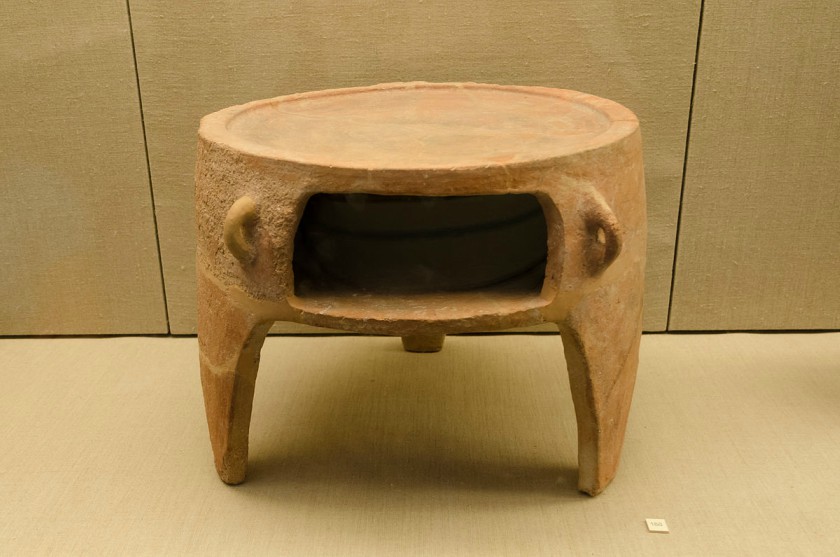
At this point, the pottery gets set aside to dry. To the inexperienced eye, the pot might seem ready for the kiln. But the expert potter knows how necessary this step is. The evaporation of excess water from the clay, greatly reduces the risk of cracking during firing.
God sometimes sets us aside too, even though we already feel ready for service. He knows the oven of fiery trials we’ll have to face in life and service. So he makes us wait, knowing how much of our own ego and pride must come out before we can really trust him, and follow in complete obedience.
The clay has gone through a lot at this point.
It’s had stuff pulled from it, and been trodden under foot. It’s been pounded, pushed, and pulled. And it’s sat on a shelf gathering dust, if you will. But all this has served a purpose. It is now prepared to withstand the heat of the oven.
But still the potter may wait
He doesn’t fire up his kiln for just one pot, but waits until he has enough to fill the oven. Then, together, he stacks them in the kiln, ready for baking.
We, like the pottery, are more useful in a team. One lone pot sitting in the pantry certainly can’t hold all the needed supplies. Nor can one pot serve every purpose. God places us in a body, because we need each other. Together we find strength to face the heat of trials. And together, with each using our own particular talents, we can fulfill God’s purposes.
The vessels must then go through fire
Only several hours of extreme heat will make them into useful items, made to last over time. Only then are they laid aside to cool, and then ready to be filled and used.
A simple but complex process
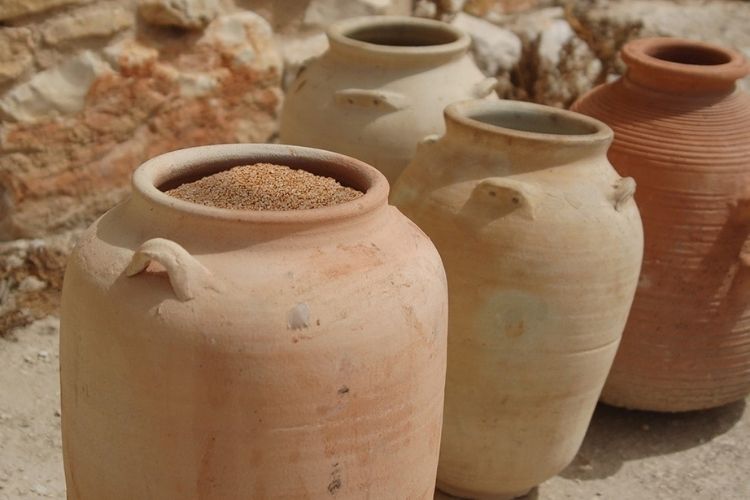
This fairly simple process, though requiring great skill, rarely produced ornate or fancy items. But archaeologists have found, along with ancient potter’s equipment, numerous remains of their pottery. Useful things, made for everyday purposes. Like the storage jars and jugs, above, created to hold and transport things like water, wine, oil, honey, grain, herbs, and spices.
Our divine potter
“O Israel, can I not do to you as this potter has done to his clay? As the clay is in the potter’s hand, so are you in my hand”“O house of Israel, can I not do with you as this potter has done? declares the Lord. Behold, like the clay in the potter’s hand, so are you in my hand, O house of Israel.” – Jeremiah 18:6 NLT
We are like that clay. Like clay in the potters’s hands, God prepares us for the particular work he has in store for us. And though it may differ greatly from our plans, it will be infinitely better. For from ordinary clumps of clay, he turns us into useful servants for his kingdom. Ordinary, but made for an extraordinary purpose!
The imagery of the Holy Spirit as the Potter’s helper is profound, as it illustrates the divine guidance and support we receive in our journey to become more like Christ. The Holy Spirit works within us, leading and guiding us towards a transformation that aligns our hearts and character with the qualities of Christ.
This analogy provides a comforting reminder that we are not alone in this process of transformation and refinement. Just as the potter meticulously shapes the clay, the Holy Spirit is actively working in our lives, helping us grow and become more like Christ.
But we have this treasure in jars of clay, to show that the surpassing power belongs to God and not to us.
2 Corinthians 4:7
Sources:
The Master Potter: Pottery Making in the Bible, by Bryant G. Wood PhD, via Associates for Biblical Research.org.
Images: Potter | Clay oven by Norbert Nagel from by Wikimedia | Clay pots on shelves & Large clay jars by David Padfield from FreeBibleImages.org.
 Signora Sheila
4 responses to “Pottery Making in Bible Times”
Oh, thank you for delving into all the intricacies of pottery making! So much depth in the Biblical application! God’s analogies are always so rich in Truth! Thank you for being His vessel and relaying His Truth to us today! <3 <3
LikeLike
I am so happy that you enjoyed it Lynn. I learned a lot by researching it, and realized why the Lord made this analogy in Jeremiah! There is such depth to it, and endless lessons we can apply to our daily walk with him. Be blessed, Sheila
LikeLike
Wonderful post! Because He is the Potter and we are the clay!!
LikeLike
So glad you enjoyed it Nancy! It was amazing to me in how many ways we are like the clay that a potter makes… and thank God that he never gives up on us but keeps molding and transforming us!
LikeLike