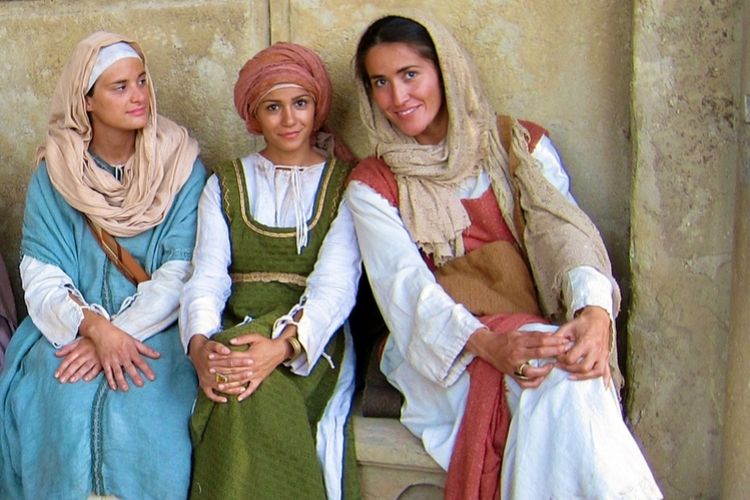
In most ancient cultures women were accorded a low status in society, sometimes even lower than animals. Even the great Greek philosophers, with their vast culture, considered them inherently inferior creatures. Aristotle once said, “Woman may be said to be an inferior to man.”
Jewish Scriptures elevated woman’s status.
But the Hebrew Scriptures valued women and their role in society was greatly appreciated in Old Testament Jewish culture. They were regarded as valuable partners and beloved companions of their husbands. And as mothers they were to be honoured, respected and obeyed (Pro. 19, Ecc. 9, Ex. 20, Col. 3, Pro. 1).
They sometimes held prominent roles
Women played a significant role in various aspects of society, even outside of the home, and they somethimes held prominent and influential positions, like Deborah the judge (Judges 4) and Queen Esther. They owned property, farmed, and performed manual labor (Pro. 31, Ruth 2). They engaged in business and commerce, like Lydia who sold purple goods (Acts 16) and Priscilla, a tent maker (Acts 18).
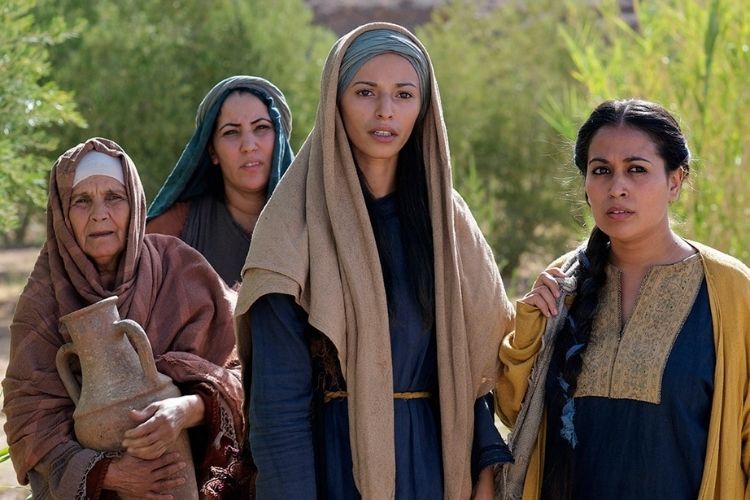
From the first chapter of the Bible, it is clear that men and women are both created in God’s image. They hold equal value in His eyes, and are equally blessed by Him. They also share joint dominion over every living thing, working together as partners.
God established the Mosaic covenant with all Israelites, including women, who were equally responsible for following God’s laws and sharing in the blessings bestowed upon his people. (Deu 29:10-11; Josh. 8:34-35)
Although women were excluded from the Levitical priesthood, they participated in temple worship and prayer (Deu. 31, 1Sam. 1, Exo. 38). They served in the temple, as did Anna the prophetess (Luke 3), and joined in religious processions, singing and playing music (Psa. 68, 2 Sam. 6).
The Old Testament also commends several women for their wisdom, including Queen Esther, who bravely risked her own life to save her people, and Abigail, who saved her household by helping King David (1 Sam. 25). Moreover, the book of Proverbs praises the wise woman in chapter 31.
Women even held important leadership roles in Israel, as evidenced by Miriam and Deborah. Miriam, a prophetess, helped lead the Israelites in the desert (Micah. 6), while Deborah served as both a prophetess and a judge in Israel (Jud. 4). Huldah was a prophetess and adviser to the king, as stated in 2 Kings 22.
Women’s low position in other ancient cultures

In many ancient ancient cultures, women occupied a lower position in the social structure.
In the Roman Empire, women were considered the property of their husbands or fathers, and had a social status barely above that of slaves. They were often confined to the home and, unless they came from a wealthy or prestigious family, were not entitled to an education.
Following the Babylonian deportation, Jewish culture underwent a significant transformation, as it became increasingly influenced by other cultures, including that of the Greeks. The Jewish Talmud, (a central text of mainstream Judaism), which was mainly written in Babylon, contains the following statements: ‘A woman’s place is at home, and a man’s place is in the marketplace’ and ‘Do not speak to a woman in the street, even if she is your wife.’
Foreign influence was also evidenced in New Testament times by the practice of restricting women to the women’s balcony of the synagogue. (It is worth noting that there is no mention of such a court in Solomon’s Old Testament temple). And by the fact that Christ’s disciples were taken aback when they saw him conversing with an unfamiliar Samaritan woman. This can be attributed to the cultural norms of the era.
The Hebrew Scriptures were the only religious texts that elevated women.

Overall, women were well respected in Jewish culture, unlike most surrounding cultures. Jewish women had the freedom to intermingle in society, in the home and elsewhere. And they played significant roles in both private and public spheres.
Anna the prophetess stayed in the temple day and night, fasting and praying (Luke 2). Lydia of Thyatira was a convert to Judaism who traded in purple goods, as described in Acts 16. Dorcas, who was possibly a wealthy widow, dedicated her time to sewing clothing for the poor (Acts 9). In Romans chapter 16, Paul sends greetings to several women whom he considered valid coworkers: Phoebe, Priscilla, Mary, Rufus’ mother, and Julia.
Mary and Martha of Bethany were known for their hospitality towards Christ and his disciples. It is not clear whether they had any occupation, but their generosity towards Jesus and his followers is well documented. Mary also had financial freedom to purchase the expensive perfume with which she anointed the Lord, John 12.
Christ and His church gave women even more value.
Women were among Christ’s earliest followers and supported his ministry. He stopped to talk with them, ministered to them, touched them, and healed them. He was born of a woman and showed concern for his mother’s care. At the cross, it was mostly women who stayed by him. They were the first to pay their respects at his tomb and, as a result, were the first to see the risen Christ.
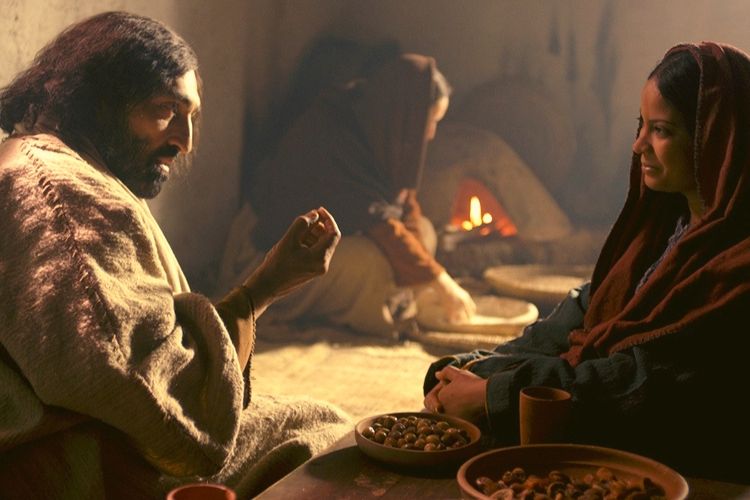
Following the example set by Jesus, the early church also held women in high esteem.
Women were present on the Day of Pentecost and played an active role in the early church. They assisted the poor, ministered to the sick, and showed hospitality.
They played an important role in the church and in spreading the gospel. Phoebe was esteemed by Paul as a deaconess in the Corinthian church (Romans 16). Priscilla, one of Paul’s valued coworkers, helped instruct Apollos, an influential scholar (Acts 18). Timothy’s mother and grandmother, Eunice and Lois, were credited with instilling a strong and sincere faith in him (2 Timothy 1).
There is neither Jew nor Greek, there is neither slave nor free, there is no male and female, for you are all one in Christ Jesus. And if you are Christ’s, then you are Abraham’s offspring, heirs according to promise.
Galatians 3:28-29
The Scriptures show that men and women are equal in God’s sight, but with distinct differences. While men were given greater leadership roles, women also held important positions and worked alongside men often in quieter and more gentle leadership roles.
Both men and women are tools in God’s hands, equally useful and important in his service, just as a seamstress needs both needles and thread. In Christ all people, including women, have true freedom and real worth.
Sources:
Sketches of Jewish Social Life, chapter 9 (Bible Study Tools)
The Biblical Portrait of Women (Grace to You)
Jesus and the Role of Women (Jews for Jesus)
Roman Education (The History Learning Site
Images from FreeBibleImages.org: 4 women going to well by http://www.LumoProject.com | Woman pouring olives by David Padfield | Women at river by Boettcher+Trinklein Television Inc | Elderly woman and Jesus, Mary & Martha by http://www.LumoProject.com. / Other images: 3 Bible women by estall
 Signora Sheila
10 responses to “The Role of Women in Bible Times”
Amen! Jesus has been showing me this view for the last few years of my journey. I came out of a church that was patriarchal in nature and had a non-Biblical view of women. Thank you for your post<3
LikeLike
Oh Julia, I am so glad that this post encouraged you. It seems there is much confusion about the role of women, and the teaching often leans too far in one direction or another. I really worked at researching this one, and what I discovered is that it’s really a much more complex situation than I realized. My hope is that this post, by presenting balanced and objective information, will help to remove some of this confusion. And as women, let us rejoice that we are highly valued and honored by the Lord himself!! Be blessed.
LikeLike
I am very honored that you are now following my blog. (Our internet has been so spotty this last week so forgive me for not commenting until now.) Off to church but I look forward to reading your words of wisdom very soon. Blessings back,
LikeLike
Thank you so much Ellie. I learn so much from your healthy insights!! Thank you! Be blessed.
LikeLiked by 1 person
Just what I needed to read! Thank you for strengthening me through this post!
LikeLike
Thank you for strengthening me with your comment! So glad this helped you! Be blessed.
LikeLiked by 1 person
Thank you for posting this. Enjoy the blessings of this day!
LikeLike
Thanks Doris, and you too! I’m glad it encouraged you! Be blessed.
LikeLike
Honey, i so appreciate your wisdom and commitment in the things of God. You are a constant source of inspiration.
Sure love you so, Your hubby
LikeLike
Thank you so much, dearie, for your encouragement. It is your constant love and devotion to the Lord that encourage me! I am so glad we are on this path together! Be blessed.
LikeLike