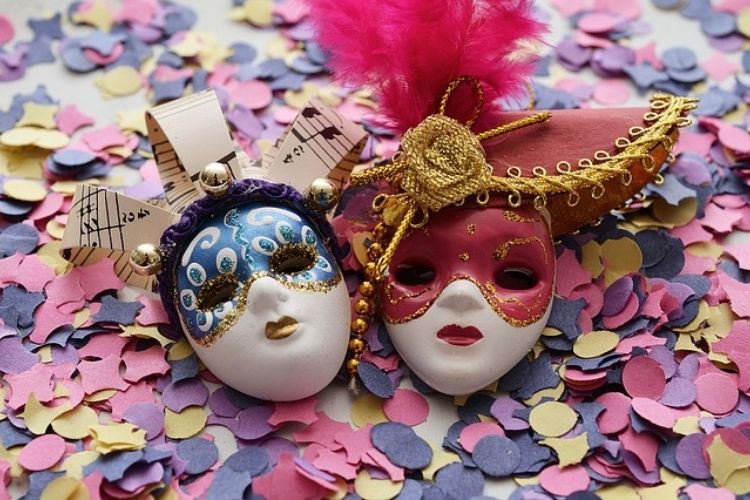
It’s Carnival, or Mardi Gras, week in Italy. And our little town, like many others, holds a traditional parade and a masked street party every year. But no Italian carnival celebration in Italy is more famous than that of Venice.
The word carnival literally means to say goodbye to the flesh. The celebration is a time of merriment before the period of Lent during which revelers assume a different identity by donning masks and costumes. And that makes them feel free to do whatever they want, even if it’s immoral. Because it’s supposedly the persona they’ve assumed that’s doing it, not them.
The history of Carnival in Italy
Carnival has long been a popular holiday here in Italy. The festival dates back to Roman times when it honored the Roman god Saturnalia. But the Church soon labeled it a “Christian” holiday and linked it to Lent.
Some early Catholic leaders condemned Carnival and its pagan practices. Pope Gregory the Great tried to make a clear distinction between Carnival and Lent. He even sent missionaries to sanctify any excesses people may have committed during Carnival.
But the people refused to give up their time of revelry and debauchery. So the church authorities eventually incorporated Carnival into their liturgical year. Despite the sexual orgies and excessive amounts of alcohol and rich food. After all, Lent was just around the corner, when they were supposed to fast and abstain.
The Venetian Carnival
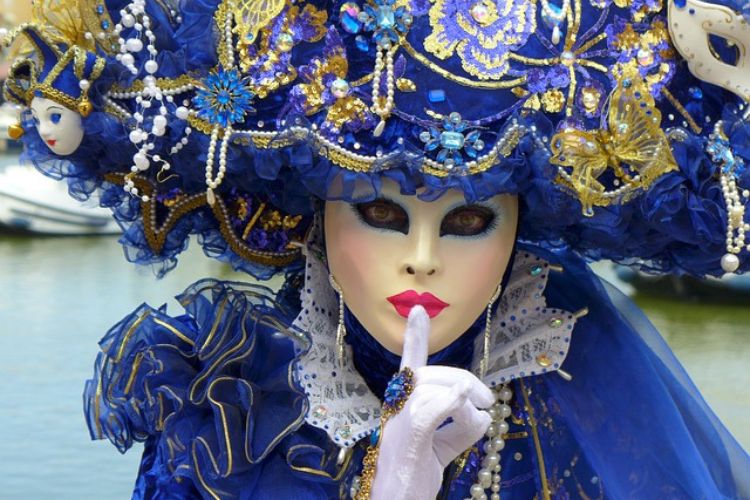
The history of the Venetian Carnival is even more interesting.
The Venetians didn’t limit the wearing of masks to the Carnival. Although no one seems to know how or why the custom began, wearing masks in public was quite common. Mask-makers held a special place in society, governed by their own laws. But city laws also regulated what masked people could do. For example, they could not gamble or play certain games.
Today, Carnival and Lent seem as intertwined as grapes and their vines. Few question either Carnival’s pagan roots or its raucous and rowdy behavior. Most Italians love the celebration. Schools typically hold masquerade parties. Towns hold street parties and parades, with the confetti thrown and horns blown.
Confetti, called coriandoli here, also has a rich history. Paper was scarce and expensive. So people threw coriander seeds (coriandoli) glued to thin layers of plaster. As paper became more common, it replaced the seeds. But by then, the name coriandoli had already taken hold.
Carnival sweets: Chiacchere and Struffoli
The Italian Carnival tradition also includes sweets, such as the Chiacchere and Struffoli. The one part of Carnival that Hubby and I love!
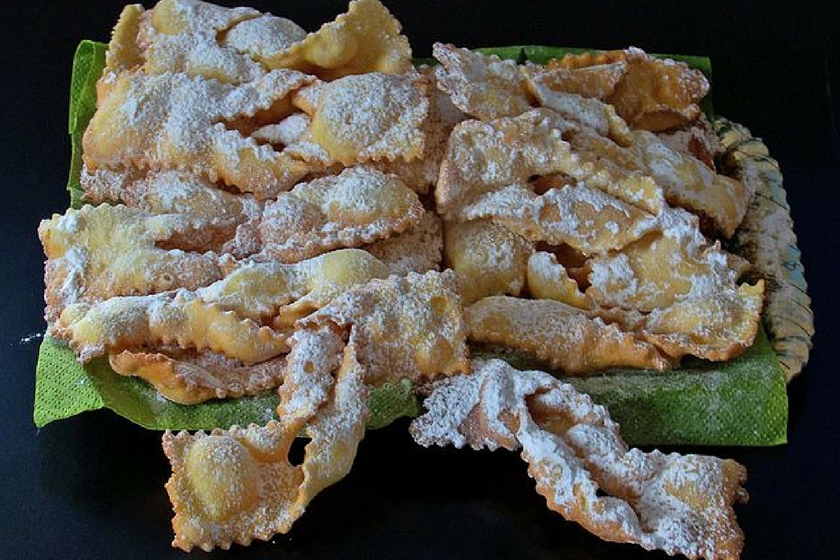
The word chiacchere means gossip or useless chatter. And it seems to come from the fact that they’re so easy to make with just a handful of ingredients. Much like gossip, where people sometimes make up all sorts of things with very few or no facts!
Struffoli have different names depending on the region. In Abruzzo they are called Cicerchiata. That’s because they’re often shaped like a circle or a ring, as the name suggests. But in my husband’s area of Salerno, they’re called Struffoli. The word struffoli is of Greek origin and means little round balls. Best of all, these delicious, honey-soaked sweets are often served at Christmas and Easter as well!

Hubby and I don’t celebrate Mardi Gras. The whole idea of hiding behind a mask to do whatever you want seems rather fraudulent to us. We’d rather deal with real people. Maskless, because we like to know who we’re dealing with. What you see is what you get.
We’ve probably all known masked people over the years. And not the Zorro type, who try to do good. They’re false friends, people who end doing harm. So the thought I’d like to leave with you is this.
Do you hide behind masks? Or are you a real person? The kind that others can trust, because you really are what you seem?
📷 Image credits: masks; carnival costume; struffoli; chiacchiere
 Signora Sheila
22 responses to “The Italian Carnival: A Venetian Tradition”
I too knew nothing of the history of carnival. It sounds much like Mardi Gras in New Orleans. I wonder how many take note that over-indulging the senses does not assuage the spirit? If anything, a person feels worse after binging! Once again, God knows best: “Eating too much honey can make you sick” (Proverbs 25:16).
LikeLike
Reread this and was stunned by the reality of how many people truly wear masks–and often don’t even realize it’s become a permanent fixture of their lives. Living authentically is a challenge today!
LikeLike
Yes, authenticity is a challenge, Dayle. But I think perhaps it always has been. It’s our nature to want to seem better than we are. We forget that only Christ can make us better!
LikeLiked by 1 person
Amen and amen!
LikeLiked by 1 person
I learned so much from what you wrote, Sheila. How eye-opening! I have never wanted to participate in events like Mardi Gras or Carnival. Your history confirms that decision. But those delicious treats might be another story for me! 🙂
LikeLike
I’ll stick with going mask-less and enjoying the strufolli. As I suspect happens in Venice and other Italian cities during Carnival (I always think of Rio De Janeiro, Brazil and New Orleans, LA), I’m sure there’s “onlookers” who watch the activities from afar without participating. I’ve been guilty of being in that crowd, but two things have convicted me in the past so I now try and avoid it all together. The first was realizing that looking at others’ sin is in itself tempting me to partake. The second was realizing that I was judging those who did choose to participate. It simply isn’t my place to judge. As for the strufolli, I’d have to remind myself that gluttony is a sin also. Gee, I want a doughnut to go with my coffee all of a sudden. :-)
LikeLike
I hear what you’re saying JD. I avoid the Carnival scene altogether because too much of what goes on is spiritually unhealthy. But the Carnival treats – those are another story! I don’t run the risk of gluttony because I’m not a huge fan of sweets, but I do enjoy tasting! And a nice fresh donught would taste really good about now!
LikeLike
I used to run a social / adventure group which organised weekends to the Venice Carnival, but I never went. I now think I really missed out on something!
LikeLike
A lot of people go and seem to really enjoy it. But it sounds like a nightmare to me. I don’t like crowds and especially rowdy ones!
LikeLiked by 1 person
Absolutely fascinating. The whole origin of Carnivale! Thanks for sharing this–it really shines a light on traditions and things I’d heard of but never really knew fully.
LikeLiked by 1 person
We didn’t know most of it either Dayle until moving over here. It’s quite a debated item among the Christian community. Although I would say that most of the younger believers don’t even consider not participating. This seems very sad to me. Glad you found the article helpful!
LikeLike
I didn’t know this, but boy did I learn a lot :)
LikeLike
Carnival is actually a very big deal here. And there is much debate among believers. Should we, or shouldn’t we. I am personally not comfortable with it. But yes, the history behind it is fascinating. But then, I’m a history buff!
LikeLiked by 1 person
It kind of reminds me of Halloween and the debate among believers, which I am not comfortable with.
LikeLike
Not comfortable with the debate or with Halloween itself? I personally don’t mind debate as long as it’s done with love and respect. But I don’t care for either Halloween or Carnival.
LikeLiked by 1 person
Oh, I meant Halloween makes me uncomfortable, meaning I don’t celebrate it. :) I don’t mind discussions either. Unfortunately, those topics tend to get heated quickly.
LikeLike
I thought that’s what you meant TR. And yes some topics get very heated. I guess we forget that it’s OK to just agree to disagree. And that showing love is more important than being right!
LikeLiked by 1 person
Definitely :)
LikeLiked by 1 person
This is a fascinating account of the origin of the Carnival… Thank you! And it makes total sense that you don’t celebrate it. I would find it impossible myself. Thank you for this informative post. So great!
LikeLiked by 1 person
For sure Lynn! Italy, as most Catholic nations, are pretty big on celebrating it. When they have the celebration here in our town, things can be pretty raucous. In early afternoon, when it’s just the kids in their costume parade, it’s not too bad, but late afternoon and evening it is not a scene we want to witness or be part of! Quite depressing.
LikeLike
Thank you for explaining Carnival and its roots, of which I was blissfully unaware. Happy to hear you don’t celebrate it. Knowing its origins, I wouldn’t either. I treasure authenticity. Jesus is our model for living authentic lives.
LikeLike
I didn’t know much about Carnival either before moving here Kathryne. A good portion of Christians don’t celebrate it, so we asked why and soon understood. The only good part for us are those yummy sweets, which Mario can’t pass up buying at the bakery. He grew up with them!
LikeLike