![Italian Liberation Day: Celebrating Freedom [Audio]](https://signorasheila.blog/wp-content/uploads/2023/04/tricolore-airplanes.jpg?w=750)
Liberation Day is one of Italy’s traditional picnic days. And today’s balmy weather has many people planning one! Which makes me wonder: do all nations have standard picnic days? I only know about Italy and the USA. Americans, of course, are familiar with picnics on Memorial Day, the 4th of July, Labor Day, and others. But ask any Italian and they’ll tell you that picnics are a must on the following holidays.
Traditional Italian Picnic Days
- Pasquetta or Little Easter – the day after Easter
- April 25 – Liberation Day celebrating freedom from Nazi Germany
- May 1 – Labor Day, or International Workers’ Day
- June 2 – Republic Day or Flag Day, celebrating the founding of the Republic
- August 15 – Ferragosto which starts the traditional summer vacation period
Many Italians celebrate the picnic days with an almost religious zeal. And they don’t skimp on the picnic spread. Normal picnic foods such as sandwiches and grilled meats are often preceded by pasta. All washed down with glasses of wine and a thermos of espresso, followed by dessert!
Hubby and I prefer to visit the parks on less busy days. The parks are crowded, making it hard to find a table, and the bathrooms become disgusting.
The first Italian Liberation Day
Italy’s Festa della Liberazione, marks the fall of Mussolini’s Italian Social Republic. And the end of the Nazi occupation in 1945.
Today it’s hard to imagine the dark political climate that preceded that day. But we know from historical accounts how dark it was.
My thoughts turn to the older Italians I knew. Like my own father-in-law, who fought in Greece. And the fascinating stories of the many older people we’ve known here over the years.
I think of their wives, sitting at home with their children, afraid for their lives. Waiting for the war to end, with its bombs and horrors. Wondering when it would come. The end that Italy and many European nations now commemorate.
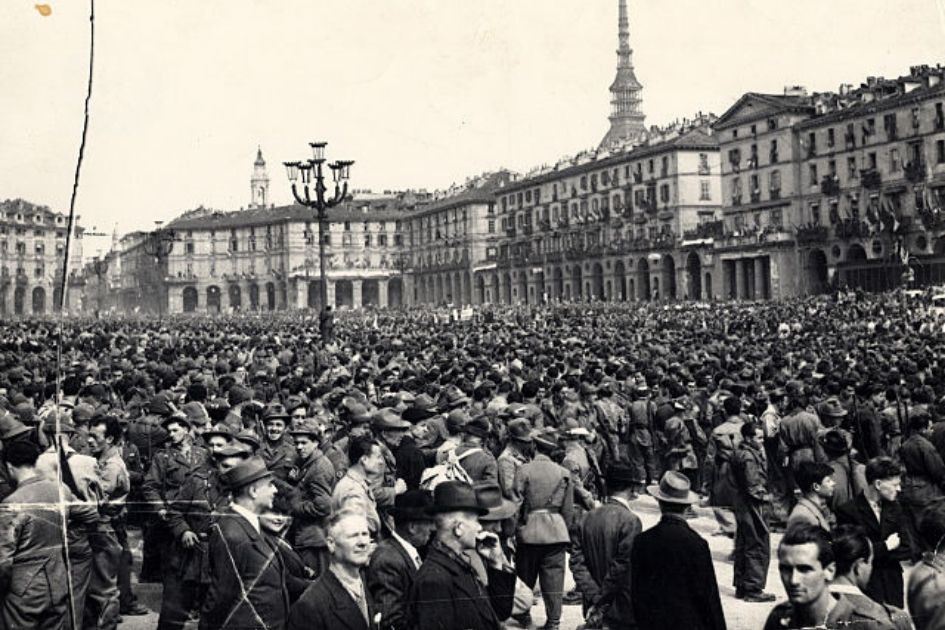
Old photos like the one above give us a glimpse of the joyful fervor of that first Liberation Day. A momentous day for Italy, and for much of the world. It brought a ray of light to the political climate, and hope to the world at large.
Not just picnics
But Liberation Day isn’t just for picnics. Schools, banks, government offices, and most businesses close on this national holiday. And in many places there are political rallies with marching bands and the Italian flag.
You’ll also find air shows, like the one pictured above, featuring the green, white, and red of the Italian flag. Plus food festivals and music concerts featuring the partisan version of the song Bella Ciao (Beauty Goodbye).
Bella Ciao was a late 19th century folk song sung by seasonal rice workers, mostly women, in the northern Po Valley. It laments the horrible conditions, long hours, and extremely low pay of rice paddy work. And that the backbreaking work that consumed their beauty and youth.
Below are the words of the original version, and an audio file you can listen to.
In the morning when I get up
Oh beauty goodbye, beauty goodbye
   beauty bye bye bye
In the morning when I get up
To the rice fields I must go

And amidst the insects and mosquitoes
Oh beauty goodbye, beauty goodbye
   beauty bye bye bye
Amidst the insects and mosquitoes
A hard work I must do

The boss stands there with his stick
Oh beauty goodbye, beauty goodbye
   beauty bye bye bye
The boss stands there with his stick
As we stoop over our work

Oh mamma mia what affliction
Oh beauty goodbye, beauty goodbye
   beauty bye bye bye
Oh mamma mia what affliction
And I cry to you each day

And every hour that we spend here
Oh beauty goodbye, beauty goodbye
   beauty bye bye bye
And every hour that we spend here
We are losing our youth

But the day will come when we all
Oh beauty goodbye, beauty goodbye
   beauty bye bye bye
The day will come when we all
Will work in liberty
Some time later the song was rewritten as a celebration of the Italian resistance movement. In this version, a partisan who is leaving for his brigade says goodbye to his beautiful lady. You can watch a video of this partisan version at the end of this post.
"One morning I got up
Oh Beautiful goodbye, Beautiful goodbye
   Beautiful bye bye bye
One morning I woke up
And found the invaders

Oh Partisan, take me away
Oh Beautiful goodbye, Beautiful goodbye
   Beautiful bye bye bye
Oh Partisan take me away
Because I feel death is coming

And if I die as a Partisan
Oh Beautiful goodbye, Beautiful goodbye
   Beautiful bye bye bye
And if die as a Partisan
You must bury me

You must bury me up in the mountains
Oh Beautiful goodbye, Beautiful goodbye
   Beautiful bye bye bye
You must bury me up in the mountains
In the shade of a beautiful flower

And the people who will pass by
Oh Beautiful goodbye, Beautiful goodbye
   Beautiful bye bye bye
And the people who will pass by
Will tell me 'what a beautiful flower'

This is the flower of the Partisan
Oh Beautiful goodbye, Beautiful goodbye
   Beautiful bye bye bye
And this is the flower of the Partisan
Who died for liberty
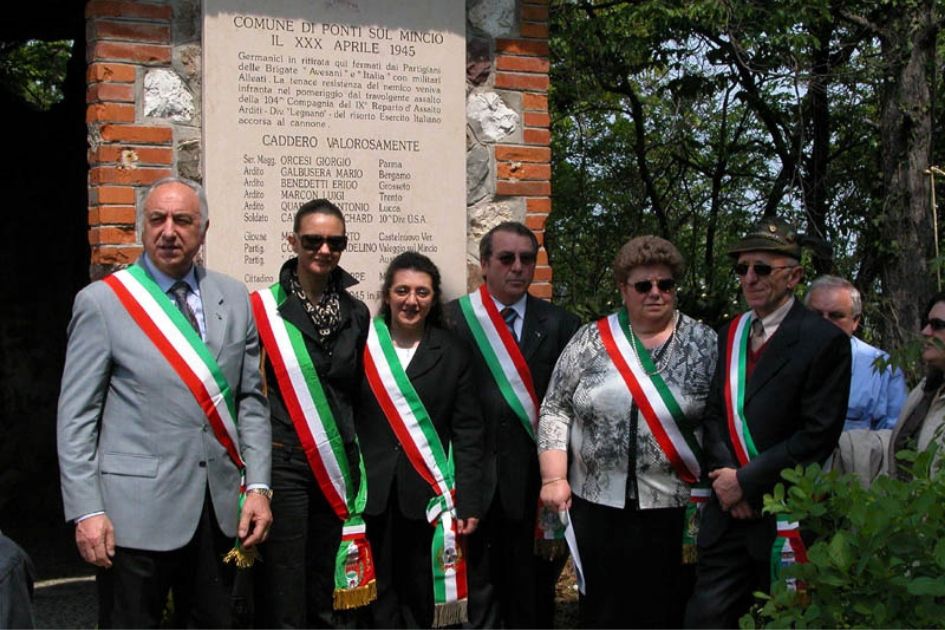
There is no doubt that Liberation Day is most appreciated by those who have lived through such terrible times. Like the partigiano (partisan) in the photo above, wearing his official partisan cap. Brave men and women who, like him, fought against the fascist and Nazi dictators of the time.
Let us hope that they will always be remembered. To prevent us and future generations from making the mistakes of the past. And because all people everywhere deserve the precious gift of freedom from tyranny.
📷 Image credits: airplanes; 1st Liberation Day by Giorgio Agosti; partisan ceremony by Ugo Franchini; audio file from Wikipedia
 Signora Sheila
9 responses to “Italian Liberation Day: Celebrating Freedom [Audio]”
I cannot imagine living through such times as the Nazi regime of the 1930s-40s. You are so right, Sheila: may we never forget the suffering of millions, caused by a relative few. And may the atrocities of that era never be allowed to happen again.
LikeLike
Those atrocities should never have been repeated. But they have, and still are in some places, even if to a lesser degree. But I hope at least we personally can learn from history and truly value our rights and freedoms!
LikeLiked by 1 person
You’re right, Sheila–I wasn’t thinking about more localized brutality, taking place all the time, somewhere in the world. As for learning from history, humankind seems to fail more than succeed at doing so!
LikeLike
Sadly true, yet we know that God can turn things around! And in the meantime, we will trust in him and try to live by Micah 6:8!
LikeLiked by 1 person
Amen–God, give me grace, strength, and perseverance!
LikeLiked by 1 person
Definitely, a remarkable reason to celebrate. Freedom is never something we should take for granted. It’s too easily lost.
LikeLike
It certainly is too easily lost. I think the erosion of freedom and rights we’ve seen too much of over these past few years. Freedom is something to truly value!
LikeLiked by 1 person
Your post reminds me that my grandfather on dad’s side who came from Italy, while ironically my father’s first visit there was storming ashore with the troops. He told me that he was pressed into duty as a translator on a few occasions and remembers after the liberation visiting his dad’s village in Calabria, where he met more Caligiuri’s than he had in his entire life! (5 brothers came to the USA and 4 stayed in Italy.)
LikeLike
What blessed memories of your heritage, Pastore Pete! I can see how you could really relate to this post!
LikeLike