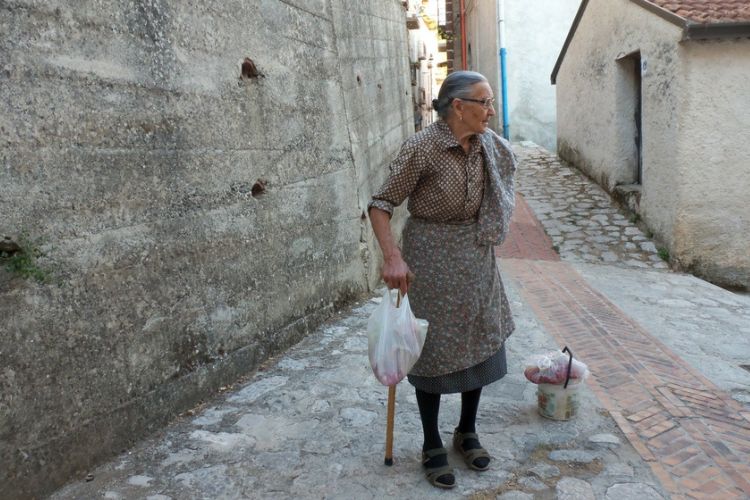
An elderly neighbor stopped my husband on the street one day. “I need to talk to you,” she said softly, through her toothless grin. “I want to apologize,” she added hanging her head. “For not showing you proper respect. But I didn’t know you were a professor! I’m so sorry!”
“Don’t worry about it, Zia (auntie)” he comforted her. I’m nobody special. You just continue to treat me as you always have.” And he added, “I’m the one who has to show you respect. You’re my elder!”
Italy’s culture of respect
Showing proper respect is an important part of Italian culture. So much so that it’s built into the language with two distinct forms of address: formal and informal.
The auntie had been using informal address with my husband. And to her, addressing him in such a familiar fashion had been a grave breach of etiquette.
But formal and informal are not the only differences. We also have to deal with singular and plural! This means that the simple word “you” is translated into four different forms; tu and Lei (both formal), and voi and Loro (both informal.) And it is this simple, innocuous word “you” that causes much of the trouble.
In most languages, verbs change depending on the subject (1st person, 2nd person, 3rd person, etc.). This is called conjugation, a basic process by which you change the verb ending in order to indicate the person doing the action. In Italian verb conjugation, each person of the verb has a different ending.
Conjugation of the simple present tense for parlare (to speak):
| 1st person | io parlo | I speak | |
| 2nd person singular | informal formal | tu parli Lei parla | you speak |
| 2nd person plural | informal formal | voi parlate Loro parlate | you speak |
| 3rd person | lui/lei parla | he/she speaks | |
| 4th person | noi parliamo | we speak | |
| 5th person | loro parlano | they speak |
And that’s just for the simple present tense of the verb “to speak.” The Italian language has 15 verbal tenses, including some that are especially confusing: remote past, past perfect, and the conditional.
Then to make it more challenging, we need to be careful about capitalization! Like with the word lei. When capitalized “Lei” means you, formal singular. But lower case “lei” is she! Likewise with the word loro. “Loro” (capitalized) means you (formal plural), while lower case “loro” is they. What a nightmare!
Is your head spinning yet? Now you know how I felt at first! Italian grammar was like an endless, dizzying carousel ride!
Italian’s formal expression
Italian has formal and informal expressions because it is one of the Romance languages that evolved from the Vulgar Latin. All Romance languages have these distinctions of speech which make make them challenging to learn.
But knowing these distinctions is essential for communicating effectively with the 85 million people who speak Italian mainly in Italy, San Marino, Switzerland, Corsica, and the Vatican City. And they are also important for business dealings and for expressing the respect that is so important to the Italian culture.
But back to the zia…
Formal speech is disappearing somewhat, as younger generations tend to be less respectful. However, in business and with older people, strangers and those in authority, it is still correct to use the formal mode.
But even if the polite grammar goes out of style, we’ll still treat our elderly neighbors with respect. Their gray heads deserve it!
Learning Italian is a big challenge, but essential if you want to live here. Or even if, as a tourist, you want to endear yourself to the locals!
But I’ll leave you with something easier: Arrivederci which means goodbye! Literally, it means “until we see each other again!” So until next time, have a great day! And be glad that you can communicate in your native tongue!
📷 Images are mine
 Signora Sheila
5 responses to “Through Her Toothless Grin {And Speaking Italian}”
This is a lovely story, intermixed with an Italian language lesson. :) I took French and Spanish in college–and am always amazed at the similarities and differences of the languages.
LikeLike
Thanks, Katie! This woman is a sweet zia! I find languages fascinating, even though they are challenging. And they’re a great key to a person’s heart!
LikeLiked by 1 person
I well remember the challenges of pronouns and the conjugations of verbs when I studied Spanish in high school. Even after four years the correct verbs did not always come automatically to mind! Kudos to you, Sheila, for taking on the challenge, to endear yourself to neighbors and friends.
LikeLiked by 1 person
Thanks, Nancy. But it was also a matter of survival for me, knowing that we would likely live the rest of our lives here. Going through life and not being able to communicate well would have been horrible!
LikeLiked by 1 person
Oh yes, verbs in other languages can be such a challenge! But people are always blessed when we try to use their language. We’ve noticed this with a lot of the immigrants here in Italy. A greeting in their mother tongue makes their face light up!
LikeLiked by 1 person